
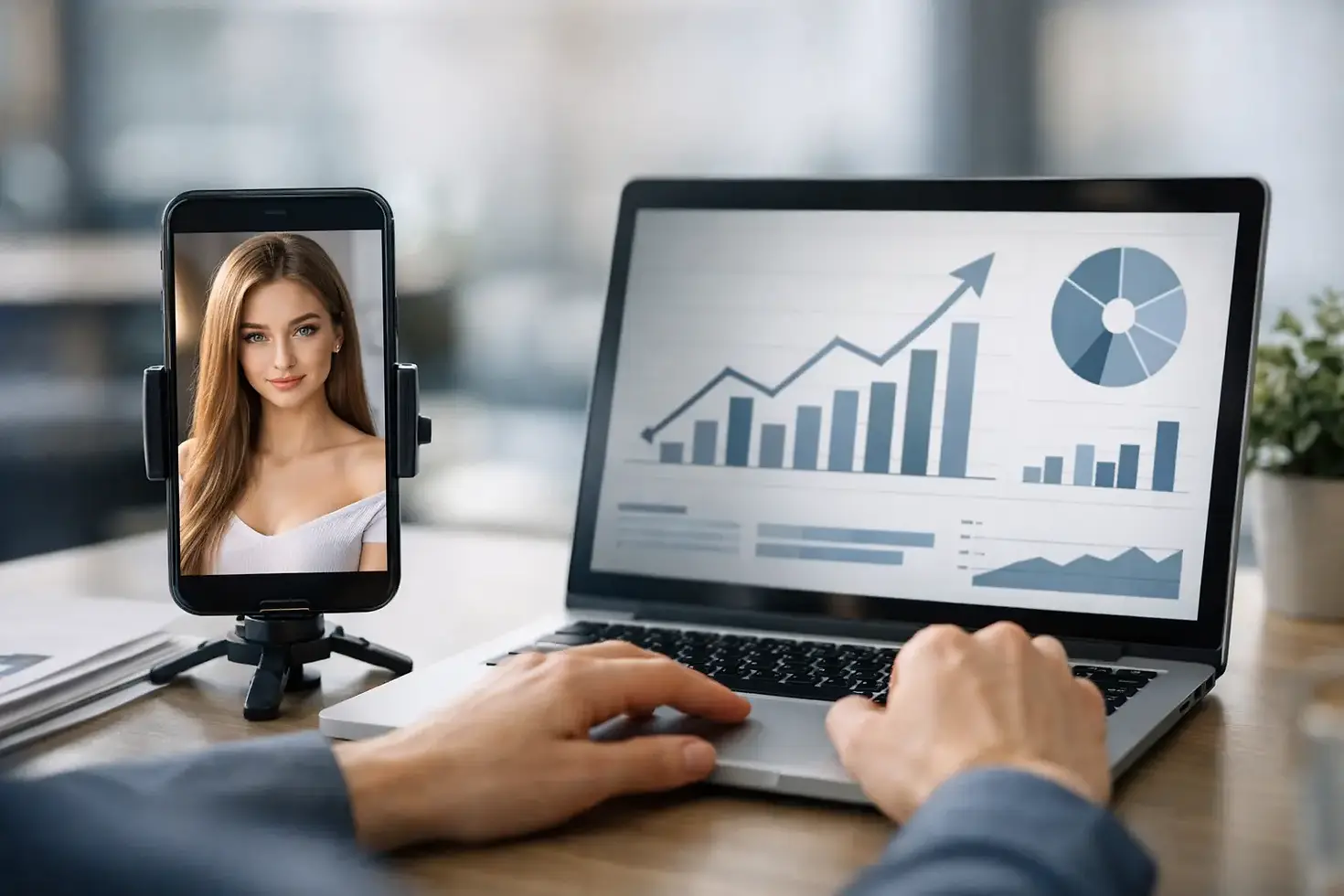
Can AI Influencers Improve Conversion Rates?

A campaign can generate plenty of likes and still leave revenue flat. That is the real question behind can AI influencers improve conversion rates - not whether they attract attention, but whether they move buyers from interest to action.
For growth teams, ecommerce brands, and founders under pressure to prove return, that distinction matters. Reach is easy to celebrate. Conversion is what gets defended in budget meetings. AI influencers are gaining traction because they offer something traditional creator partnerships often cannot: a consistent, controllable, always-on brand presence built for performance as much as visibility.
Can AI influencers improve conversion rates in real campaigns?
Yes, they can improve conversion rates, but not by magic and not in every scenario. They work best when they are treated as a strategic conversion asset rather than a visual experiment.
An AI influencer can be designed around a brand's exact market position, audience expectations, and purchase journey. That changes the economics of influencer marketing. Instead of hoping a creator naturally communicates the right message, brands can shape the persona, the voice, the visual style, the product framing, and the call to action with much greater precision.
That level of control matters because conversion usually depends on clarity, repetition, and trust. Human influencers can absolutely deliver those outcomes, but they often come with variability. Messaging drifts. Content calendars shift. Creative quality changes from post to post. An AI influencer gives brands a more stable system for storytelling, product education, and offer presentation across channels.
The result is often a stronger path from discovery to consideration to purchase, especially for brands that need high content volume, consistent positioning, and faster testing cycles.
Why AI influencers can influence buyer behavior more effectively
Conversion improves when buyers see the right message in the right format at the right moment. AI influencers are well suited to that because they are built for repeatable, brand-safe execution.
First, they create continuity. A buyer may discover a product through a short-form video, then see the same persona in retargeting creative, a product demo, a seasonal campaign, or a live shopping experience. That repeated exposure from the same branded character can strengthen recall and reduce friction. Instead of disconnected campaign assets, the brand presents a recognizable digital spokesperson who carries the same message forward.
Second, they make product storytelling more disciplined. Human creators are often strongest when a brand wants spontaneity and borrowed audience trust. AI influencers are strongest when a brand needs message consistency at scale. If your offer requires specific positioning, compliance sensitivity, or category education, a custom AI persona can present benefits in a cleaner and more conversion-focused way.
Third, they support faster optimization. Conversion rate improvement usually comes from testing, not intuition. Different hooks, visual styles, offer framings, and call-to-action sequences can be deployed quickly when the influencer asset is already owned and controlled by the brand. That means more room to refine what actually drives clicks, add-to-carts, bookings, or purchases.
Where AI influencers tend to perform best
AI influencers are especially effective in categories where presentation and repetition shape the buying decision. Beauty, wellness, fashion, travel, and lifestyle brands often benefit because the content can blend aspiration with product demonstration. A well-designed AI persona can show routines, styling ideas, product pairings, or destination experiences with a polished, always-on content engine behind it.
They are also valuable in credibility-sensitive sectors, though the strategy changes. In fintech, tech, legal-adjacent services, and B2B innovation, conversion often depends less on personality alone and more on trust, clarity, and professional consistency. In those spaces, an AI influencer should not feel gimmicky. It should feel intelligent, aligned with the category, and highly intentional. When executed correctly, the persona becomes a branded expert presence that explains, reassures, and guides prospects toward the next step.
This is where a tailored system matters. A generic avatar rarely improves conversion. A digital persona built around industry tone, audience psychology, and campaign objectives has a much stronger chance.
What actually drives conversion, not just engagement
Brands sometimes assume an AI influencer will convert because it looks modern. That is the wrong benchmark. Novelty can lift attention for a moment, but conversion comes from structure.
The first driver is audience-fit persona design. If the influencer does not reflect the values, visual language, and communication style your audience expects, the content may attract curiosity without building trust. A luxury skincare buyer, a wellness subscriber, and a SaaS decision-maker respond to very different signals.
The second driver is content architecture. Conversion-oriented AI influencer campaigns are not just a stream of attractive posts. They include awareness content, product education, objection-handling content, social proof framing, offer-led creative, and retargeting assets. The persona is most effective when it shows up across that full funnel instead of being limited to top-of-funnel attention.
The third driver is commercial clarity. Buyers need a reason to act now. That can be a product benefit, a problem solved, a limited-time offer, an easier buying path, or a stronger emotional reason to choose the brand. AI influencers can deliver those prompts with consistency, but they still need a sharp campaign strategy behind them.
Can AI influencers improve conversion rates better than human influencers?
It depends on the campaign goal.
If the priority is immediate borrowed trust from an established creator's audience, a human influencer may have the advantage. That is especially true for launches where community loyalty and personal endorsement are doing most of the selling.
If the priority is scale, control, repetition, and long-term brand ownership, AI influencers often have the stronger conversion framework. They do not replace every human creator relationship. They solve a different business problem.
Human influencers are powerful, but they are external partners. AI influencers are brand-built assets. That difference matters. A custom AI persona can be deployed on schedule, adapted for multiple products, localized for different audience segments, and aligned tightly with campaign performance goals. Over time, that can create a more efficient and measurable conversion engine than relying only on creator availability and interpretation.
The most effective brands will not treat this as an either-or decision. They will use AI influencers where consistency and conversion discipline matter most, and use human creators where lived experience and community transfer are the bigger advantage.
How to use AI influencers to improve conversion rates
Brands that see results usually start with one question: where is friction happening in the buyer journey? If users are engaging but not purchasing, the answer may be weak product explanation. If traffic is landing but not converting, the issue may be poor offer framing or inconsistent retargeting creative.
An AI influencer can then be developed to address that exact friction point. For a beauty brand, that might mean routine-based product storytelling with before-and-after framing. For a fashion label, it could mean style-led content that shortens decision time. For a fintech or B2B brand, it may involve concise educational content that makes a complex offer feel more accessible and trustworthy.
From there, the strongest campaigns build around continuity. The same persona appears in short-form social content, paid creative, product pages, launch announcements, and promotional storytelling. That repeated presence creates recognition, and recognition supports action.
This is also where a consultative build matters. AI Quantum Labz approaches AI influencer development as a branded performance system, not a one-off visual asset. That distinction is what turns a digital persona from an interesting concept into a commercial channel.
The trade-offs brands should consider
AI influencers are not a shortcut around strategy. If the persona is poorly designed, visibly disconnected from the audience, or deployed without a clear conversion goal, results will disappoint. Buyers are more receptive to AI-powered brand characters than many marketers assume, but they still respond to relevance and quality.
There is also a transparency and brand perception consideration. Some audiences welcome futuristic brand representation. Others may need a more careful introduction. The right level of disclosure, tone, and realism depends on the category and customer relationship.
Creative ambition should also be balanced with operational discipline. A beautiful AI influencer is not enough. The content must sell clearly, the funnel must be measured, and performance signals must guide iteration.
That is why the real advantage is not simply that an influencer is AI. The advantage is that the brand can combine authenticity-driven storytelling, precise execution, and scalable production in a way traditional influencer programs often struggle to sustain.
The brands that win with AI influencers will be the ones that stop asking whether the format is new and start asking whether it is engineered to convert. When a digital persona is built with audience insight, message control, and performance intent from day one, conversion stops being a side effect of content and becomes part of the design.


Comments