
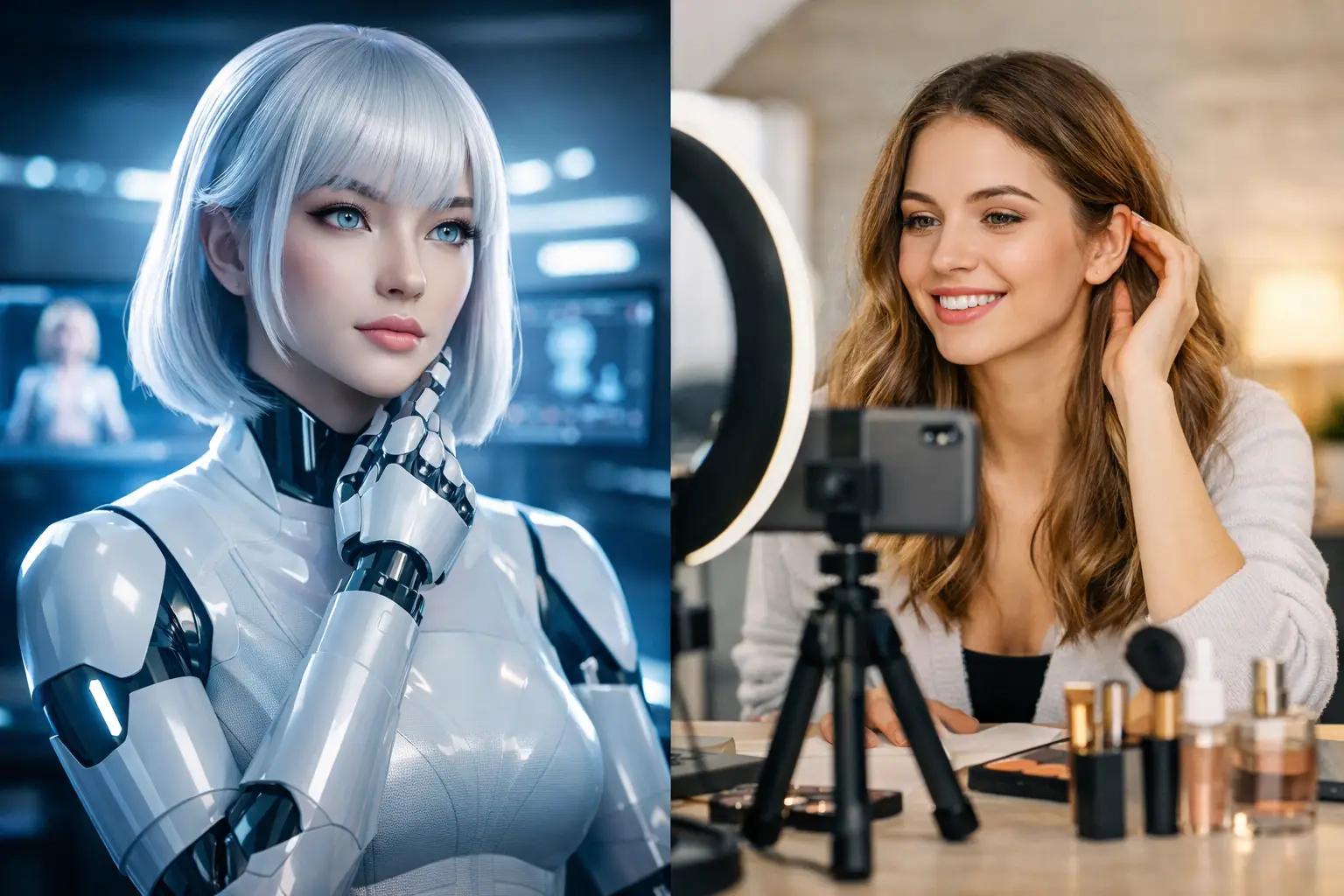
AI Creators vs Human Influencers

A product launch is three days away, your creator misses a deadline, and the campaign calendar does not care. That is the moment the conversation around AI creators vs human influencers stops being theoretical and becomes operational. For brands under pressure to produce content faster, stay on-message, and prove return, the choice is no longer about novelty. It is about control, consistency, and commercial performance.
This comparison matters because most brands are not deciding between one or the other in a vacuum. They are deciding how to build a modern influencer strategy that can scale without losing relevance. Human influencers still carry cultural credibility and emotional immediacy. AI creators bring precision, availability, and a level of brand alignment that traditional partnerships often struggle to maintain.
AI creators vs human influencers: what really changes for brands
The biggest shift is not visual. It is strategic. Human influencers are independent media channels with their own audience dynamics, personal brand decisions, and variable turnaround times. AI creators are brand-built assets. They can be trained around your tone, product positioning, visual identity, and campaign goals from day one.
That difference changes how marketing teams plan. With a human creator, you are negotiating collaboration. With an AI creator, you are shaping an owned spokesperson system that can generate repeatable content across campaigns, formats, and channels. For ecommerce brands, that can mean faster product storytelling and more consistent performance creative. For finance, legal, or B2B brands, it can mean a more polished and controlled public-facing persona in categories where trust and message discipline matter.
This does not make human influencers obsolete. It makes the decision more specific. If your goal is cultural momentum tied to a recognizable individual, a human creator may be the better fit. If your goal is scalable branded storytelling with fewer operational gaps, AI often becomes the stronger business solution.
Where human influencers still win
Human influencers bring lived experience. That still matters, especially in categories where community connection drives purchasing behavior. A beauty creator explaining how a formula feels on skin, a travel personality documenting a real trip, or a founder-led voice sharing a personal opinion can create a level of social proof that feels immediate and persuasive.
They also carry established audience trust. When the right creator has spent years building credibility with a niche community, brands can benefit from that relationship. The endorsement feels contextual rather than manufactured. For certain launches, trends, or cultural moments, that energy is hard to replicate.
There is also creative unpredictability, which can be an advantage. Some of the best-performing influencer content does not come from strict control. It comes from a creator interpreting a brief in a way the brand did not expect. That kind of instinct can produce standout moments.
But these strengths come with trade-offs. Human creators have schedules, opinions, changing aesthetics, and competing partnerships. Brand safety can become an issue. Messaging can drift. Production quality can vary. Even strong relationships introduce friction when a campaign needs multiple revisions, rapid localization, or continuous publishing over time.
Where AI creators pull ahead
AI creators are built for repeatable brand performance. They do not go off-brief, age out of a campaign identity, or disappear during a critical launch window. They can be designed to reflect a specific audience aspiration, category tone, and visual language with unusual consistency.
That consistency matters more than many teams admit. Across social, paid media, product education, livestream shopping, and promotional storytelling, audience trust is often shaped by repetition. A digital persona that looks, sounds, and behaves in line with the brand can strengthen recognition over time. Instead of renting influence campaign by campaign, brands can develop an always-on presence.
AI creators also expand what is possible operationally. A single persona can appear in multiple content formats, adapt to seasonal campaigns, support product demos, and speak to different verticals while staying aligned to a core identity. That creates efficiencies in production, approvals, and content planning. For growth teams under pressure to do more without expanding creative headcount, that is not a small advantage.
There is a financial argument too. Human influencer campaigns often involve recurring negotiation, variable usage rights, reshoots, and limited content lifespan. AI creators require strategic development upfront, but they can generate longer-term value because the asset is designed for ongoing deployment. Over time, the economics can become more favorable, especially for brands with steady content demand.
Authenticity is not as simple as people think
The common objection is obvious: can an AI creator feel authentic? The better question is what audiences actually mean by authenticity. In practice, authenticity is not only about whether a person is biologically real. It is about whether the content feels coherent, intentional, and honest about what it is.
An AI persona presented as a fabricated human with vague disclosure creates trust problems. An AI persona presented clearly as a branded digital identity with a strong voice, purposeful storytelling, and relevant content can feel authentic in a different way. It becomes authentic to the brand experience rather than authentic to a personal life.
That distinction matters for modern marketing. Many buyers are not looking for raw intimacy from every brand touchpoint. They want clarity, relevance, and content that reflects the world they want to belong to. If a digital creator delivers that with style and consistency, audiences often respond well.
Human influencers still hold an edge when authenticity depends on firsthand experience or personal testimony. Wellness routines, lifestyle transformation, and deeply personal categories often benefit from a real person speaking from lived context. But in product-focused campaigns, aspirational branding, educational content, or stylized storytelling, AI creators can perform extremely well because the value comes from message quality and visual impact, not biography.
AI creators vs human influencers by use case
The strongest strategy usually comes from matching the creator model to the job.
For product launches that need speed, consistency, and a polished visual system, AI creators are often the cleaner option. They can produce launch teasers, social assets, explainers, and promotional storytelling without the coordination burden of multiple outside partners.
For community-driven campaigns where audience trust is tied to personality and personal opinion, human influencers often remain effective. That is especially true when a niche audience follows a creator for taste, expertise, or lifestyle relatability.
For regulated or credibility-sensitive sectors such as fintech, legal, healthcare-adjacent services, or B2B innovation, AI creators can be a strategic advantage. Brands in these spaces often need a spokesperson presence without the unpredictability that comes with creator controversy, off-brand commentary, or loose messaging.
For retail, beauty, fashion, travel, and arts-focused campaigns, the answer may be both. Human creators can generate reach and social proof. AI creators can extend the campaign with branded continuity, additional content volume, and visual storytelling that stays live long after the initial collaboration ends.
The real decision is ownership versus access
At a business level, AI creators vs human influencers often comes down to ownership versus access. Human influencers give brands access to an audience they do not own. That can be valuable, but it is temporary and dependent on the creator relationship. AI creators give brands an owned media asset designed around their goals, aesthetics, and growth model.
That ownership changes the long-term value equation. It allows a brand to build a recognizable digital persona that evolves with the business, supports campaign after campaign, and becomes part of the brand architecture rather than a one-time promotion. For companies that care about precision, efficiency, and sustained visibility, that is a meaningful shift.
This is why the future is not a simple replacement story. It is a portfolio story. Human influencers will continue to matter where social trust and personal perspective are central. AI creators will continue to grow where scale, control, and consistency create competitive advantage. The smartest brands will stop treating these as opposing camps and start building systems where each serves a specific role.
For companies ready to think beyond one-off posts and toward a more durable influencer presence, that shift is already underway. Agencies such as AI Quantum Labz are building AI creator ecosystems not as experiments, but as high-performance brand assets designed for engagement, storytelling, and measurable growth.
The better question is not whether AI will replace human influence. It is whether your brand is still relying on borrowed attention when it could be building an influential presence of its own.


Comments